


Two Stories About AI. One Portfolio That Doesn't Have to Choose.
Two respected research desks looked at the same technology and reached opposite conclusions. We think the right response is structural, not a guess about who is right.
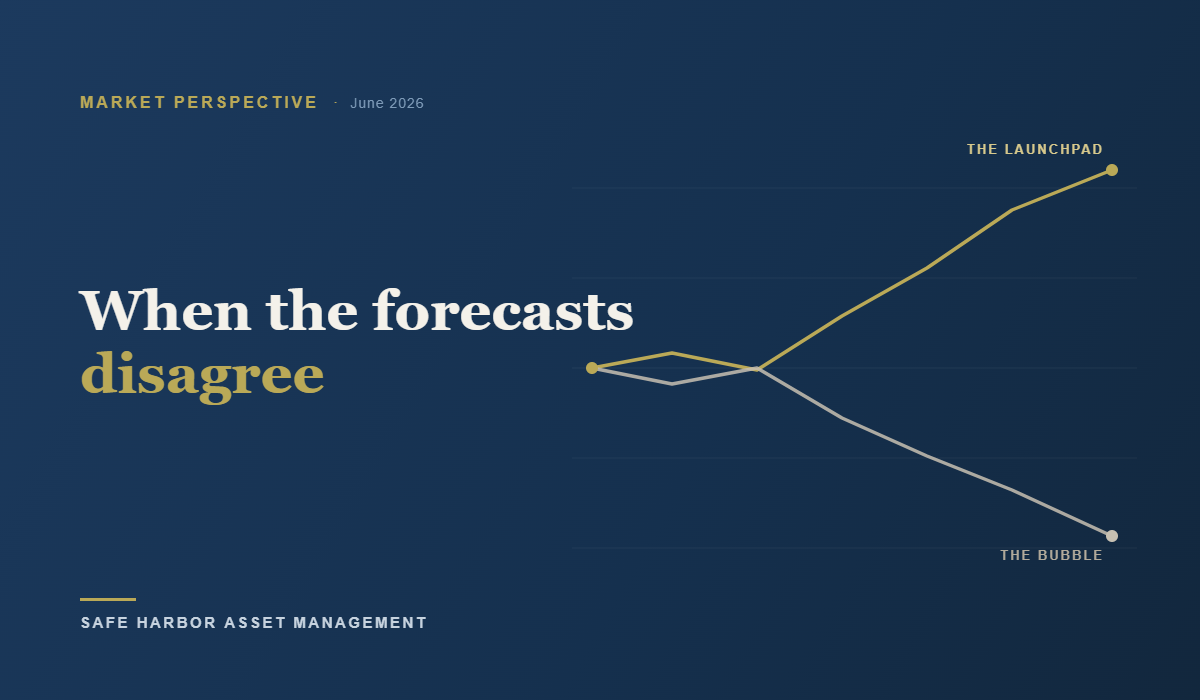
Bloomberg Economics modeled what happens if the AI trade is a bubble and it bursts. Apollo highlighted evidence that AI is quietly igniting the largest wave of new-business formation in a generation. Both are credible. Both could prove true. The temptation for investors is to decide which to believe and position accordingly, and that, we would argue, is precisely the wrong instinct.
The cautionary case: if the bubble bursts
Using a new global scenario tool, Bloomberg estimates a collapse in AI valuations could erase roughly $1.6 trillion from world output, more than Switzerland produces in a year. The scenario assumes U.S. equities fall about 20%, credit spreads widen, and data-center construction stalls. U.S. growth in 2027 would slump from near 2% toward 0.4%, with Taiwan and South Korea, levered to semiconductors, hit hardest, and the Fed cutting three or four times. The strains look more like 2000 than 2008: a confidence shock, not a financial cascade.
The optimistic case: if it's a launchpad
Apollo points the other way. New-business formation has surged, and nearly all of the growth comes from solo founders: individuals who, armed with AI tools, can now do what once took a team. If even a fraction of these ventures scale, the employment and productivity implications are large. The economist's name for it is Jevons paradox: when a resource grows dramatically cheaper, we don't use less of it, we find vastly more uses for it. Cheaper intelligence doesn't shrink the economy. It multiplies it.
Why you don't have to choose
These stories run on different clocks. Bloomberg describes a possible market event: sharp, near-term, painful. Apollo describes a diffusion process: gradual, broad, multi-year. History suggests both can unfold in sequence. Railways and the internet each delivered genuine, economy-wide gains, but typically only after a speculative mania, a crash, and a long lag before the productivity showed up in the data. Bet the portfolio on the boom and you are exposed to Bloomberg's scenario; retreat entirely to cash and you forfeit Apollo's. The prudent posture is to be built for the range.
When the experts genuinely disagree, that disagreement is information. It is the market telling you the future is unusually wide.
The concentration hiding in "diversified"
Here is the uncomfortable part. Many portfolios that look diversified no longer are. The major U.S. equity index has grown heavily concentrated in a handful of mega-cap technology names whose fortunes are tied to the very AI capital cycle Bloomberg is modeling. Owning "the market" today increasingly means owning one bet, dressed up as many. Counting holdings is not the same as diversifying risk. And this is not only the bears' worry: Apollo, the source of the optimistic case above, has separately flagged that same concentration as a central risk to the market.
The Safe Harbor approach: an Engineered Risk Budget
This is the gap our Engineered Risk Budget (ERB) approach is designed to close. Conventional allocation thinks in dollars, the familiar 60/40 split. But risk does not distribute the way dollars do. In a typical 60/40 portfolio, equities can drive the overwhelming majority of total volatility; the portfolio is far more concentrated in equity risk than its dollar weights suggest.
The ERB starts from the opposite end. We first decide how much risk a portfolio should carry, then deliberately allocate that risk budget across return drivers that do not move in lockstep, so that no single factor, including the AI and mega-cap equity factor, is permitted to dominate the outcome. In practice that means engineering exposure to genuinely distinct sources of return: equities for long-run growth, balanced against income-producing real assets, real estate and private structures, and the segments of the economy least leveraged to the AI build-out, the very areas Bloomberg notes would be least exposed if the trade unwinds.
The result is a portfolio designed to remain standing if the bubble bursts, while still participating in the broad, patient upside if the entrepreneurial wave is the story that wins. It captures that diffusion through breadth, rather than chasing it through the narrow names most vulnerable to a drawdown.
We don't claim to know which story the next three years will tell. Our job is not to forecast the winner; it is to build portfolios that don't depend on guessing right. The ERB is how we translate that humility into structure.

Important disclosures: Investment Advisory Services offered through Safe Harbor Asset Management, Inc. (“Safe Harbor”), an SEC-Registered Investment Adviser. Advisory services are only offered to clients or prospective clients where Safe Harbor and its representatives are properly licensed or exempt from licensure. All investing involves risk, including the possible loss of principal; past performance is no guarantee of future results. No advice may be rendered by Safe Harbor unless a client service agreement is in place.
This commentary reflects the personal opinions, viewpoints and analyses of Safe Harbor employees and should not be regarded as a description of advisory services provided by Safe Harbor or performance returns of any client. The views expressed are provided for educational and informational purposes only, contain opinions that should not be construed as facts, and are subject to change at any time without notice. Nothing herein constitutes investment, tax, or legal advice, an offer or solicitation, or any recommendation that any security, portfolio, transaction, or investment strategy is suitable for any specific person. Safe Harbor manages client accounts using a variety of techniques and strategies not necessarily discussed here.
This commentary contains forward-looking statements and references third-party scenario analyses, which are inherently uncertain; actual results may differ materially from any outcomes described. Information from third parties is obtained from sources believed to be reliable but is not guaranteed as to accuracy or completeness, is illustrative only, and does not constitute or imply endorsement. Diversification and risk-budgeting approaches do not assure a profit or protect against loss in declining markets. Investors cannot invest directly in an index.
Sources: Bloomberg, "What Happens If the AI Bubble Bursts," June 7, 2026 (Bloomberg Economics SHOK scenario analysis); Apollo Global Management, "The Daily Spark: AI-Driven Explosion in the Number of Entrepreneurs" (T. Slok), June 7, 2026; Apollo Global Management (Apollo Academy), “S&P 500 Concentration Approaching 50%” (T. Slok), 2026. Figures reflect third-party scenario analysis and are not forecasts by Safe Harbor.




0 comments